
Captain Norman Barnes
Captain Norman Omar Barnes was a Captain within the Army Intelligence Corps during the Second World War. He saw extensive service, being deployed to Italy, Egypt, the Middle East and finally India. He served initially in the Royal Artillery, then at Bletchley Park with the Intelligence Corps before operating within Field Security Sections on operations in Italy.
In December of 2024, his family donated much of his Army possessions to us – the Military Intelligence Museum – including his medals, insignia, diaries (where detailed accounts of his military career are relayed). But most impressively, through his skills as a painter, portions of his service have been visually recorded through a vast and dazzling collection of paintings.
In particular, Barnes' service in Italy (1944) has been immortalised through his impressive and extensive depictions of the campaign. The Military Intelligence Museum has been lucky enough to acquire these paintings from his deployment to Italy, these paintings make up almost all the artworks that were donated by his family. This rare and phenomenal collection of watercolour and ink works open a window through time, allowing us to vividly witness the Italian Campaign from a unique perspective, incomparable to any documentary or publication on the matter.
This online exhibition endeavours to encapsulate the life and achievements of Norman Barnes wholistically, the bulk and focus of this exhibition is thus centred on his experiences in Italy during the Second World War. It should be noted however that these paintings were not dated and only vaguely labelled, and so a considerate effort has been made to order these paintings chronologically based on Allied operations in Italy, and what little information we have from Barnes' memoirs.
Norman Omar Barnes was born in 1909 in Johannesburg, South Africa, where he spent his early childhood. His family later returned to England in 1916 when his father enlisted into the Army to serve in the Great War. After the war, his family moved to Manchester, where Norman achieved a scholarship in Modern Languages at Manchester University, where he achieved a First. He spent a year in Paris studying art and sculpting in 1934, strengthening his passion for art and developing his abilities in the French language.
His early years demonstrated his affections for art, particularly painting, as well as demonstrating his academic abilities when it came to languages, by which time he was fluent in both French and German.
When war broke out in Europe for the second time, he joined the Home Guard, before being called up for active service with the Royal Artillery Corps in 1941, though he was quickly transferred to the Army Intelligence Corps as his proficiency in French and German gained their attention.
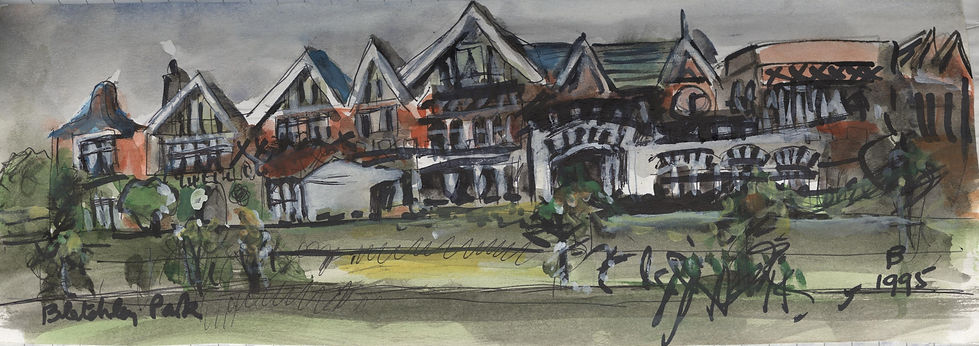
Bletchley Park (Above) – depicted by Barnes here through biro, watercolour and ink – was the principal site during the Second World War for Allied codebreaking. Barnes would serve the first portion of the war here.
Bletchley Hall (Below) - This ink and watercolour (Barnes preferred a combination of mediums) depicts the famous Bletchley Hall, the mansion on the estate and Headquarters for the codebreakers during the war. Note: due to age, some of the blue watercolour used in the sky has faded to magenta.

Within the Intelligence Corps he was posted to Bletchley Park where he served as an officer, helping to translate German communications that had been deciphered from the infamous ‘Enigma machine’, which to him and his colleagues was referred to - in hushed tones - as “machine”.
Bletchley Park
In 1944, Norman Barnes was deployed to Italy, serving as an officer within a Field Security Section (FSS). The Italian Campaign is what has been so extensively documented and captured through Barnes’ talents as an artist, but his works detail the events prior to landing in Italy, in the Mediterranean, which is where this chronology of artworks begins...
The Mediterranean Sea
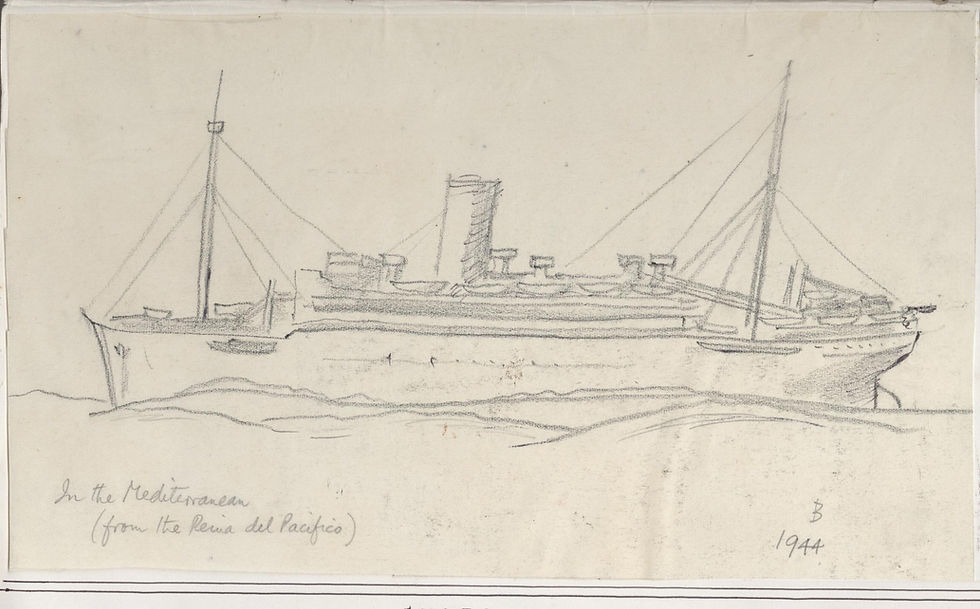
Linework & Pencil recordings of ships in the Mediterranean Sea
Previously civilian ships were employed by the Royal Navy to act as troopships throughout the war, hence their cruise ship silhouettes.
.jpeg)
.jpeg)
.jpeg)
(Below) Perspective drawing of decks onboard Troopship, Mediterranean Sea
Barnes captures a sunrise onboard his troopship. The early sun casts long shadows across the decking, while his comrades look out to sea. Notice the introduction of naval weaponry on the decks of a previously civilian vessel.

(Below) Mixed Media portrayal of the Port of Naples
The Port of Naples had been secured by the Allies on the 1st of October 1943. Once captured, the port was used to land allied forces into Italy. Barnes arrives here sometime in early 1944.


Naples Harbour (Above)
Despite a limited number of mediums to choose from, Barnes is able to create an effective appearance of light hitting both the bow of this ship and across the water, using white acrylic as opposed to coloured pencil.
(Below Left) Rushed sketch of an Allied Vehicle
The harshness of the linework and the overall rushed appearance of this drawing suggests that Captain Barnes produced this in a short amount of time, likely between duties.
(Below Right) Watercolour & ink sketch of Soldier in Battle Dress Uniform and Cap


This seemingly rushed art style seen in the above sketches is apparent across the majority of the following artworks. In all cases it is understandable that adequate time, or even a permissive environment, would not have always been possible as Barnes snatched moments between duties to record the world around him.
After arriving in Italy, Captain Barnes stayed in Recale, a small commune inland, before being temporarily stationed in Pompeii, 20km southeast of Naples – effectively on the other side of Mount Vesuvius. Unfortunately, due to a lack of information regarding his precise duties, we do not know the reason for his postings, only that his service there occurred months after Pompeii’s capture from the Axis powers.


The Balcony & Vesuvius (Above Left) – This watercolour and ink drawing shows a couple of Barnes' comrades enjoying a late evening discussion on the balcony of their accommodation in Recale. Notice the looming silhouette of Vesuvius in the top left. (Above Right) - Depiction of his room interior.

Left – Mixed medium study of Pompeii ruins
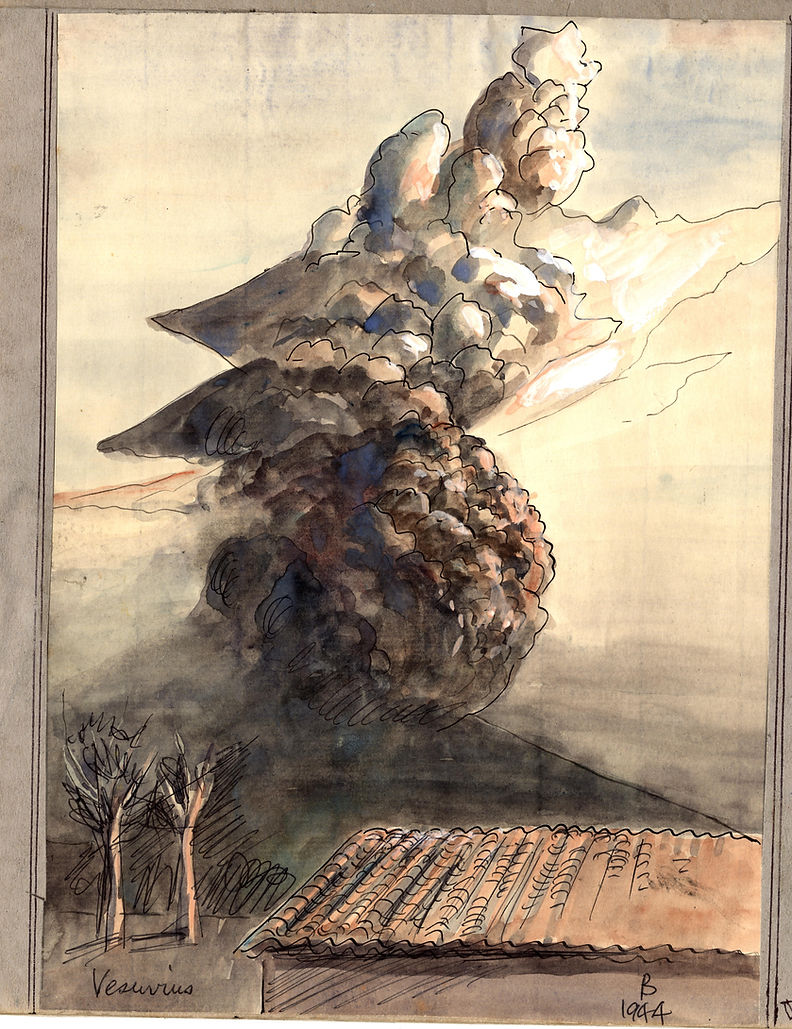
Vesuvius eruption – 17th March 1944 (Below)
Easily the most striking rendition in this collection is Barnes’ depiction of the eruption of Mt Vesuvius, an event that lightly hindered allied operations in Italy for several days. Barnes has used thick layers of watercolour and bright paint to create a sharp separation between light and dark on the ash cloud.
Pompeii
Bari, southern Italy
(Below) - Mixed medium depictions of the countryside enroute to Bari. The use of black crayon is unique here, used to cast thick shadows on the trees and buildings in the mid ground, as well as force a bleak tone into the sky above.


Captain Barnes and his FSS travelled to Bari, a city on the east coast of Italy facing the Adriatic Sea. Again, we do not know the precise reason for his posting there, nor the exact date of this posting. The city had been captured by allied forces in the months prior.

The church of St Nicholas, Bari (Above), and the Cathedral of Bari (Left)
Rome
Rome had been captured by the Allies on the 4th of June 1944 - the D-Day landings would occur two days later, marking a definitive turn in the tide of war. It is likely that Barnes arrived in Rome soon after its capture, providing a brief role in intelligence consolidation closely behind the main advance north.


(Above) St Peter’s, Rome
This is perhaps the most attentively drawn illustration out of the collection, using a wide mixture of mediums, even including oil paint to capture the light cast onto the pillars and dome.
(Left) Stone sculpture
Little context is provided with this artwork, but it is likely that this rendition is of a statue from within one of Rome's main cathedrals (possibly St Peter’s).
Bolsena, central Italy
From Rome, the Allied advance continued north. In the autumn of 1944, Barnes was stationed in and around Bolsena, a small town some 80km north of Rome. His time there is briefly detailed in memoirs, but more extensively detailed in his artworks of the scenery and of his camp.
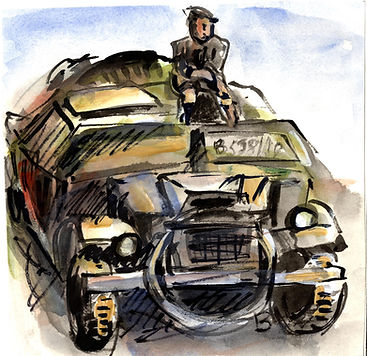
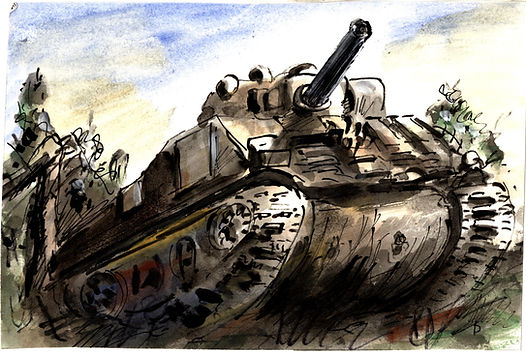
(Above Left) – British Army ‘Daimler Dingo’ armoured scout car illustrated here with ink and watercolour.
(Above Right) – M4 Sherman in British use traversing terrain and thick vegetation, again depicted using thick ink mediums and drab watercolour.
(Below) - Watercolour and fine liner renditions of Barnes' camp overlooking Lake Bolsena.


(Above) Dawn view of Allied camp. Note the subtle use of orange and the long shadows cast behind tents and foliage to masterfully portray the early time of day.
(Left) Perhaps the most revealing illustration in the collection, this inked tent interior gives a modest glimpse into the everyday life of the soldier. Rather than impressive landscapes, views and armoured vehicles, we are shown basic equipment and a first-person perspective of where much of the time on campaign would have been spent.

Tuscany,
northern Italy
Barnes arrives in Tuscany, further north from his previous posting in Bolsena, and manages to capture these stunning watercolours of the rolling countryside. It is clear from the palette and mediums used that his time in Tuscany was accompanied by a spell of poor weather. His paintings here are dark, bleak and grey. The way in which he almost saturates his paper with dark inks and watercolours sell the scene and force the same bleak mood onto us.
%20bleak%20watercolour%20res600con40.jpeg)
Siena
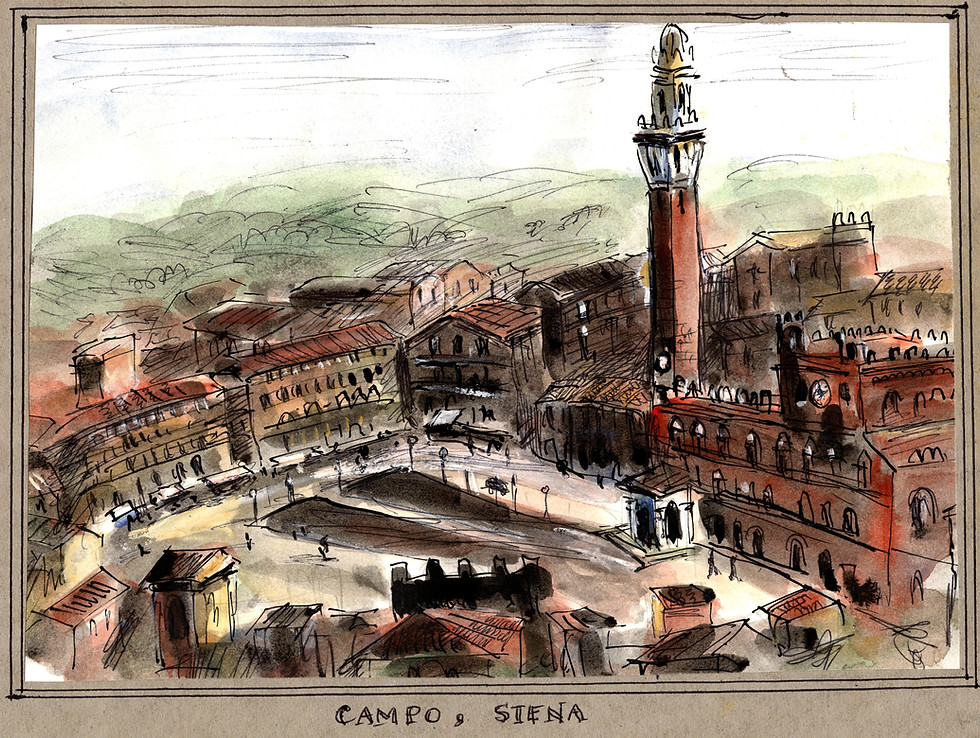
Barnes' arrival in Siena, the medieval city in the centre of the Tuscany region, clearly proved a source of inspiration for his artistic abilities. The city is prominent for its Gothic and 13th century architecture, which thankfully was largely undamaged during the allied aerial bombardments earlier that summer. Here (Above), Barnes has rendered an evening depiction of the Siena square – presumably sketched from the top of the ‘Duomo di Siena’, a 13th century Gothic Cathedral to the west.

'Duomo di Siena'
The aforementioned Cathedral, depicted here (we believe) from the top of the clock tower in the Siena square in the painting above.
These two illustrations effectively mirror one another, as each is drawn from the perspective of the other.

Camp outside Siena.

Linework illustration of the rolling landscape surrounding the city.
(Below) Mixed medium rendition of landscapes outside Siena.

The collection of artworks ends presumably where Barnes' service in Italy ends, here in Siena. Beyond this point, and much like most of his service in Italy, his next postings and activities within the Intelligence Corps are unknown to us. We only understand that at some point later on in his military career he served postings in India and the Middle East.
Later Years
Following Barnes' final posting after the war, Barnes was discharged and returned to England, where he became the senior lecturer of Modern Languages at Salford University. He remained there until his retirement in 1969. His retirement was spent in the countryside where he continued his hobby for landscape paintings.

Norman Barnes in lecturers robes at Salford University c.1960
Exhibition by Henry Murfitt